(This page is better on desktop/laptop rather than on mobile. Sorry!)
Growing Innovation Capability in Teams – a relational approach
Kia ora, Chibai and Namaskaram – welcome to my PhD work on growing innovation capability in teams! My findings are simple (heh):
Three things seem to matter:
First, a shared narrative that helps people locate themselves and gives direction when certainty isn't available. (I use the Hautū Waka design methodology).
Second, tools that make the narrative real in day-to-day work.
And third, growing from these first two, collective dispositions (muscles) that develop through practice, and help the team use the tools well.
Basically, IF teams enter a narrative, a shared mythic container of language and meaning, AND use tools to make that narrative real in concrete ways in their 'innovation' work, THEN they will grow their collective capability to wayfind in complexity.
Simple. Heh.
Thank you for your interest!
-Baruk (@reflexiv.co) in case you want to email me :)
The 5 layers of this artefact
Hautū Waka — a Māori wayfinding framework developed by Roimata Taniwha-Paoo and Ayla Hoeta at the Auckland Co-design Lab, under the guidance of Matua Rereata Makiha. Six phases, each both a stage and a state. You move between them as conditions require, sometimes progressing, sometimes cycling back. It holds the team and the work, providing shared metaphor, language and meaning-making for wayfinding in uncertainty, innovation, and change.
Tools — nine tools to help teams apply the Hautū Waka phases to their own contexts of innovation and/or change in uncertainty. Organised into three groups: The Inner Landscape (tools for better conversations), Reading the System (making sense of complex contexts), and Holding Direction (drawing action-oriented maps). Some were used in the fieldwork, and others come from my wider practice. They're a useful place to start rather than a full set, and you will find that your existing tools can be used to fit the narrative.
Muscles — five collective muscles needed to grow innovation and/or change capability in teams working in uncertainty, one for each dimension of Te Whare Tapa Whā (after Mason Durie): Whenua (of the land, place and identity), Taha Whānau (of relationships with others), Taha Hinengaro (of the heart and mind), Taha Wairua (of the spirit and purpose), and Taha Tinana (of the body). These muscles aren't built through training. They emerge through the collective work of practising Hautū Waka together, and they belong to the crew, living between people rather than inside any one person.
The Mycorrhizal Network — the reading, watching and listening that fed this work. Pacific wayfinding traditions, complexity theory, relational approaches to capability, indigenous knowledge systems. The underground connections that made this possible. Also not specified – all the many conversations with people, living and dead; with the earth, the sky and water; and my dearest friends Dee, Greg, Sarah, Cole and Koda. Thank you.
The Tap Root — my positionality. As Tangata Tiriti, I chose to work with knowledge from this place, Aotearoa New Zealand. Why I care, where I stand, how I see. The ground everything else grows from.
Context: Dancing Landscapes
Scott Page describes three types of landscapes for understanding problems. Simple landscapes have clear paths — you can see where you're going and follow established routes. Rugged landscapes are difficult but navigable — like heart surgery or launching rockets, they're complicated problems solvable through established procedures if you have the right expertise. Dancing landscapes are different. They shift constantly as multiple actors respond to each other, creating conditions that change even as you move through them. Complex problems aren't harder versions of complicated ones; they're a different kind, requiring navigation rather than execution.
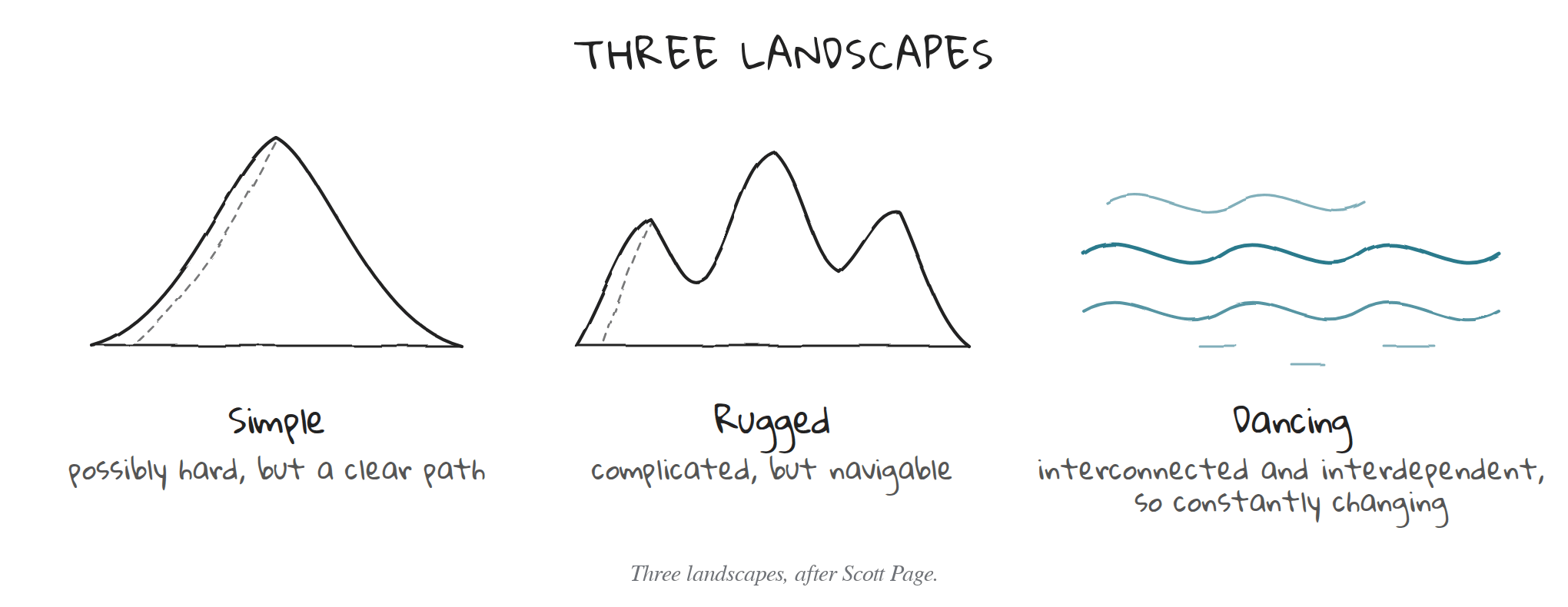
The ocean is the most dancing of landscapes. Currents shift, weather changes. The navigator can't follow a predetermined route because the conditions that existed when planning began are not the conditions encountered en route. Polynesian wayfinders developed practices for exactly this — reading signs continuously, adjusting course, sometimes returning, always in relationship with a world that won't hold still.
Hautū Waka draws from these Pacific navigation traditions. It's designed for situations where you can't know the path before walking it — where the landscape itself responds to your movement, where diverse and connected actors create conditions no one fully controls. This is the terrain of innovation.
Three things stand out about Hautū Waka. First, as a design process, it assumes complexity — you read signs, make choices, possibly return. The waka can go forward, around, or back. Second, the framework is recognised rather than taught. For Māori and Pacific peoples, wayfinding is already familiar; for others, journeying is universal enough to carry meaning without requiring methodology training. Third, the unit is the collective — those who can fit in a boat. Rather than entire organisations, we're thinking here of teams working on a shared challenge. You have to be in the waka to participate in its direction and trajectory.
This artefact is for those crews.
Design Methodology: Hautū Waka
Downloadable pdf of Hautū Waka in the Resources – click here.
Tools for Wayfinding
Downloadable pdfs and links for tools in the Resources – click here.
The collective 'muscles' you build
Click on each aspect of Te Whare Tapa Whā for detail. Downloadable poster in the Resources.
My Mycorrhizal Network
Hover on items for book/article names